Novel Sensors Inc.
Leaks / Spoilage / Hazards

Find them faster. Act faster.

More sensing points. A clearer picture of where gas appears and spreads.

NSI's technology enables gas sensor blankets, strips and custom systems for distributed gas sensing.

Hydrogen sensing demonstration with a 240-sensor prototype.

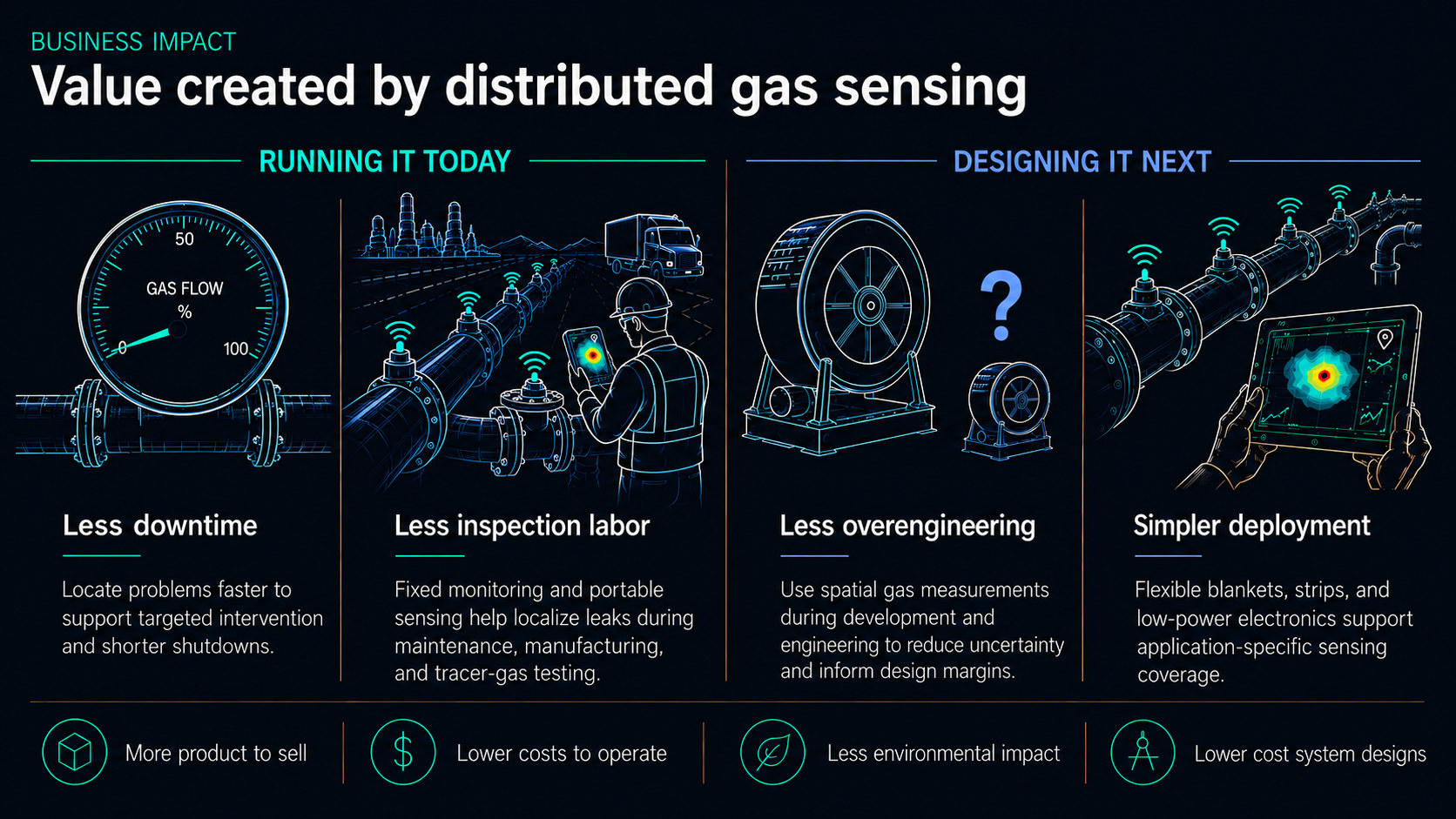
Value created by distributed gas sensing. Running it today: less downtime through targeted intervention and shorter shutdowns; less inspection labor through fixed monitoring and portable sensing for maintenance, manufacturing and tracer-gas testing. Designing it next: less overengineering through spatial measurements that inform design margins; simpler deployment through flexible blankets, strips and low-power electronics. Benefits include more product to sell, lower operating costs, less environmental impact and lower-cost system designs.
NSI prototypes & custom development

Distributed sensing, shaped for your equipment.

Two configurations for distributed sensing: coverage across an area or along a narrow path.

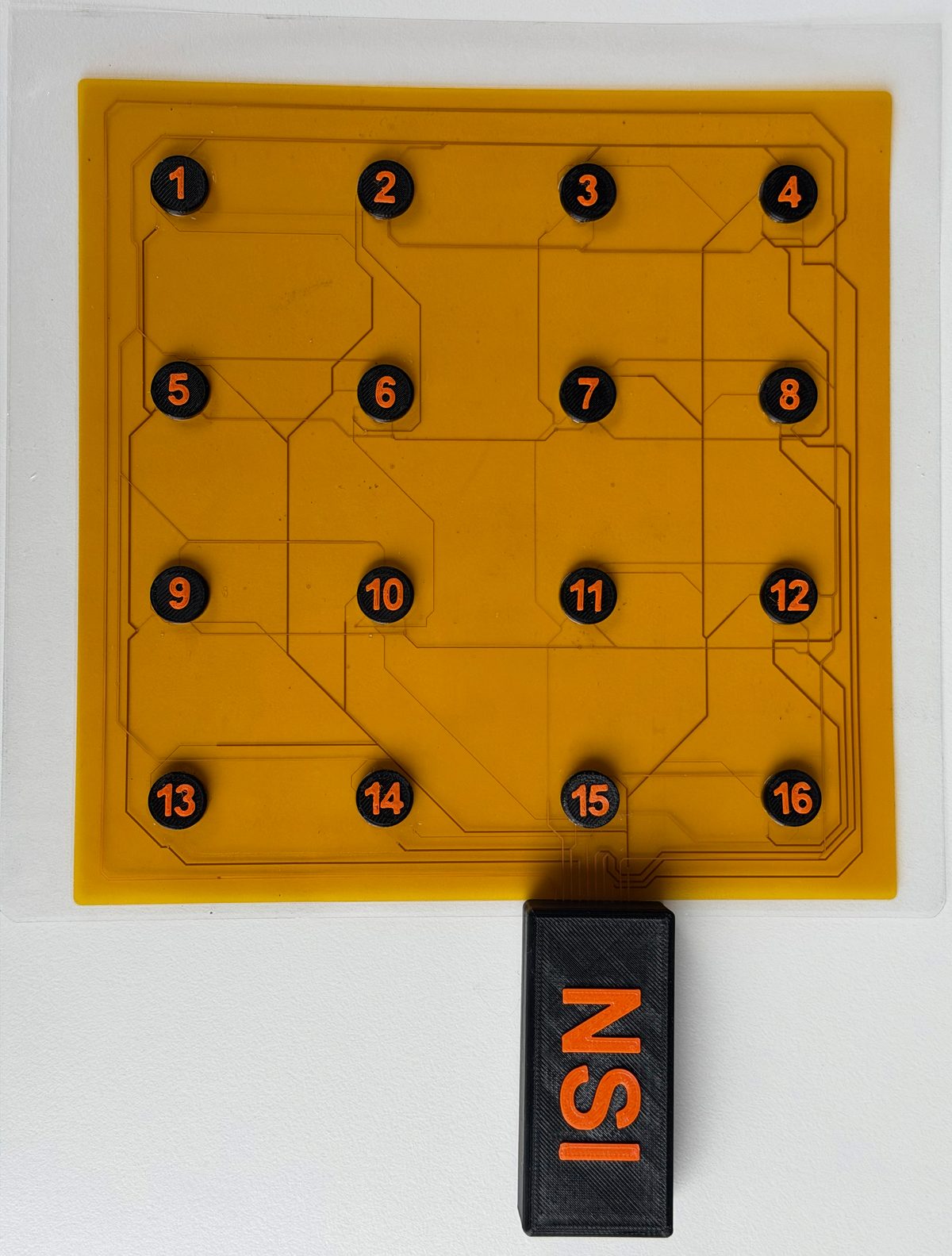
NSI sensing blanket prototype showing sixteen sensing locations distributed across a flexible area

Sensing blankets

Distribute sensing points across an area to help locate gas releases around equipment or within an enclosure.

Discuss blanket evaluation

NSI sensing strip prototype with eight sensing locations along a flexible strip and electronics at one end

Sensing strips

Arrange sensing points along a narrow path—such as a pipe, a row of connections, or an enclosure edge—where an area blanket would be unnecessary or difficult to fit.

Discuss strip evaluation
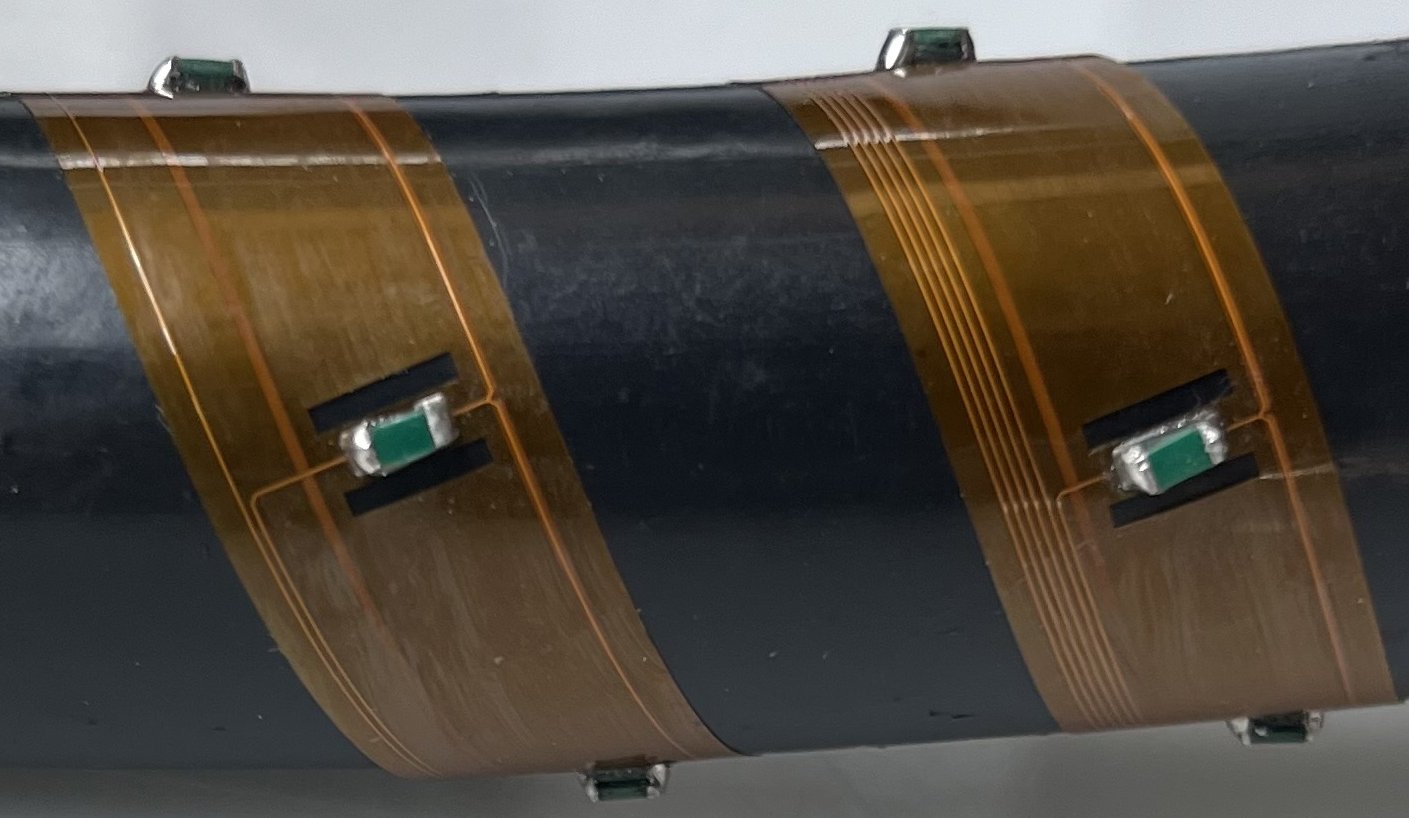
NSI sensors mounted on flexible Kapton circuits wrapped around a pipe, demonstrating integration around curved equipment
Flexible sensor integration shown; application designs include protective sensor housings.
Custom sensing systems

Your equipment. Your sensing layout.

Bring sensing into tight spaces and around complex surfaces. NSI adapts sensor placement, protective housings and measurement electronics to your application.

From a one-off engineering setup to arrays designed for deployment across multiple units.

Discuss a custom build →
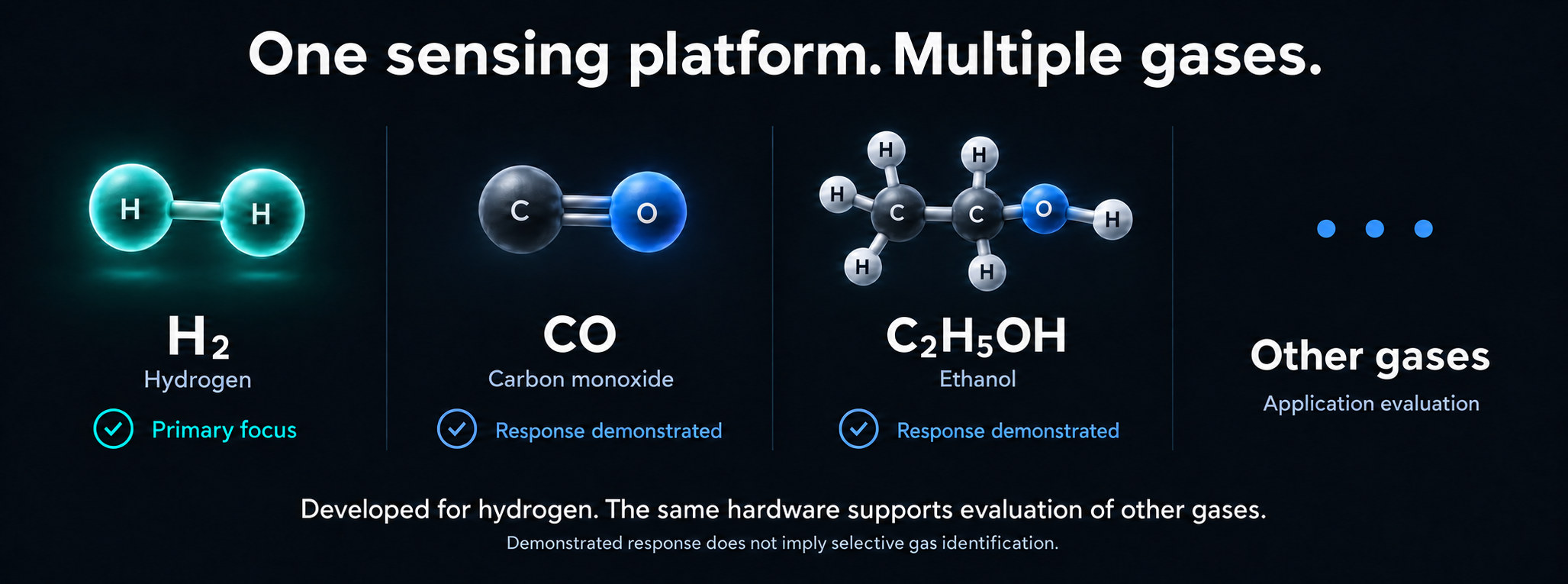
One sensing platform. Multiple gases. Hydrogen is the primary focus. Responses demonstrated for carbon monoxide and ethanol. Other gases require application evaluation. Developed for hydrogen; the same hardware supports evaluation of other gases. Demonstrated response does not imply selective gas identification.
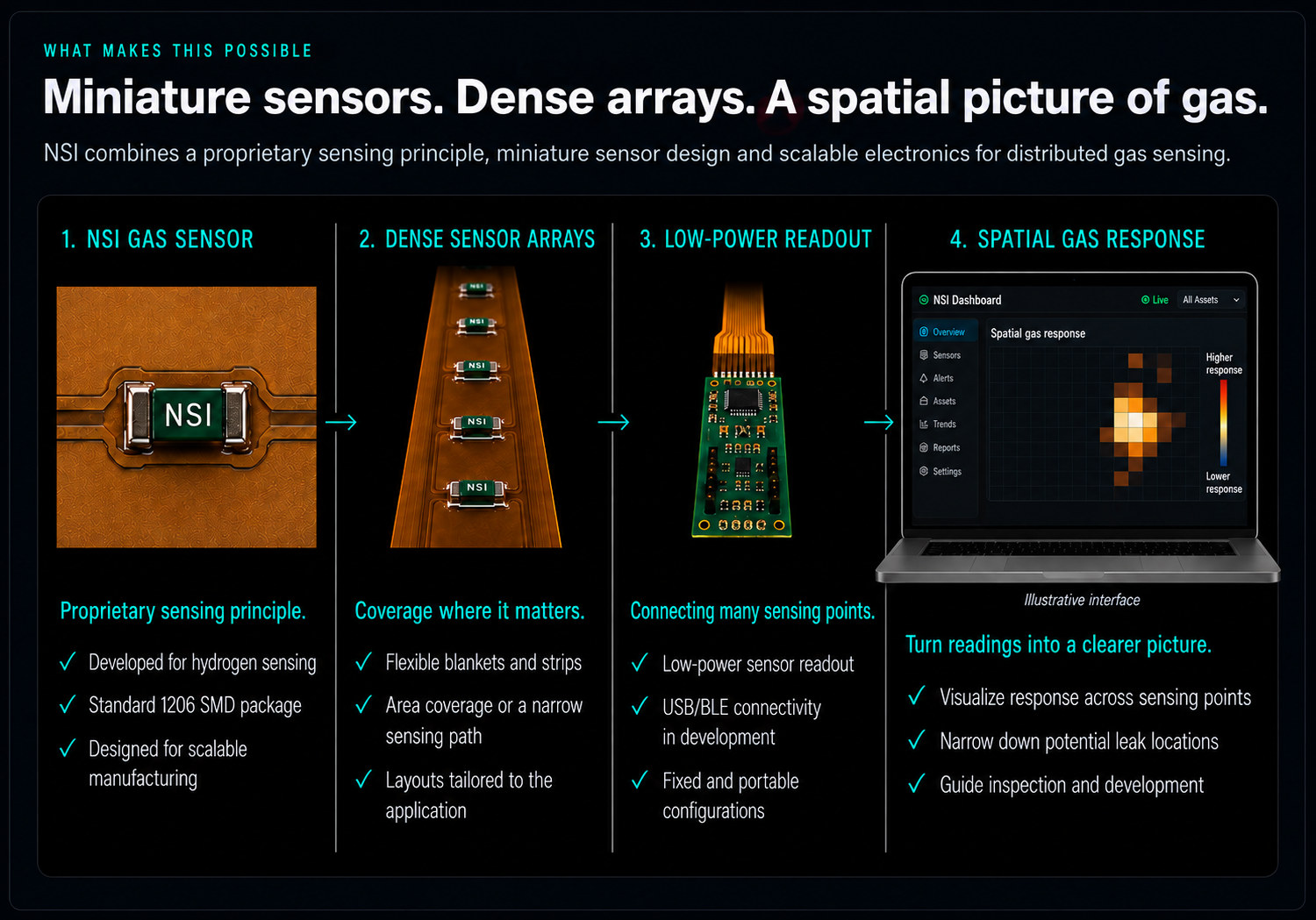
What makes this possible: NSI combines a proprietary sensing principle, miniature sensor design and scalable electronics for distributed gas sensing. NSI gas sensor: developed for hydrogen, standard 1206 SMD package, designed for scalable manufacturing. Dense sensor arrays: flexible blankets and strips for area coverage or a narrow sensing path, with layouts tailored to the application. Low-power readout: USB/BLE connectivity in development and fixed and portable configurations. Spatial gas response: visualize response across sensing points, narrow down potential leak locations and guide inspection and development. Dashboard is an illustrative interface.

Measured hydrogen response

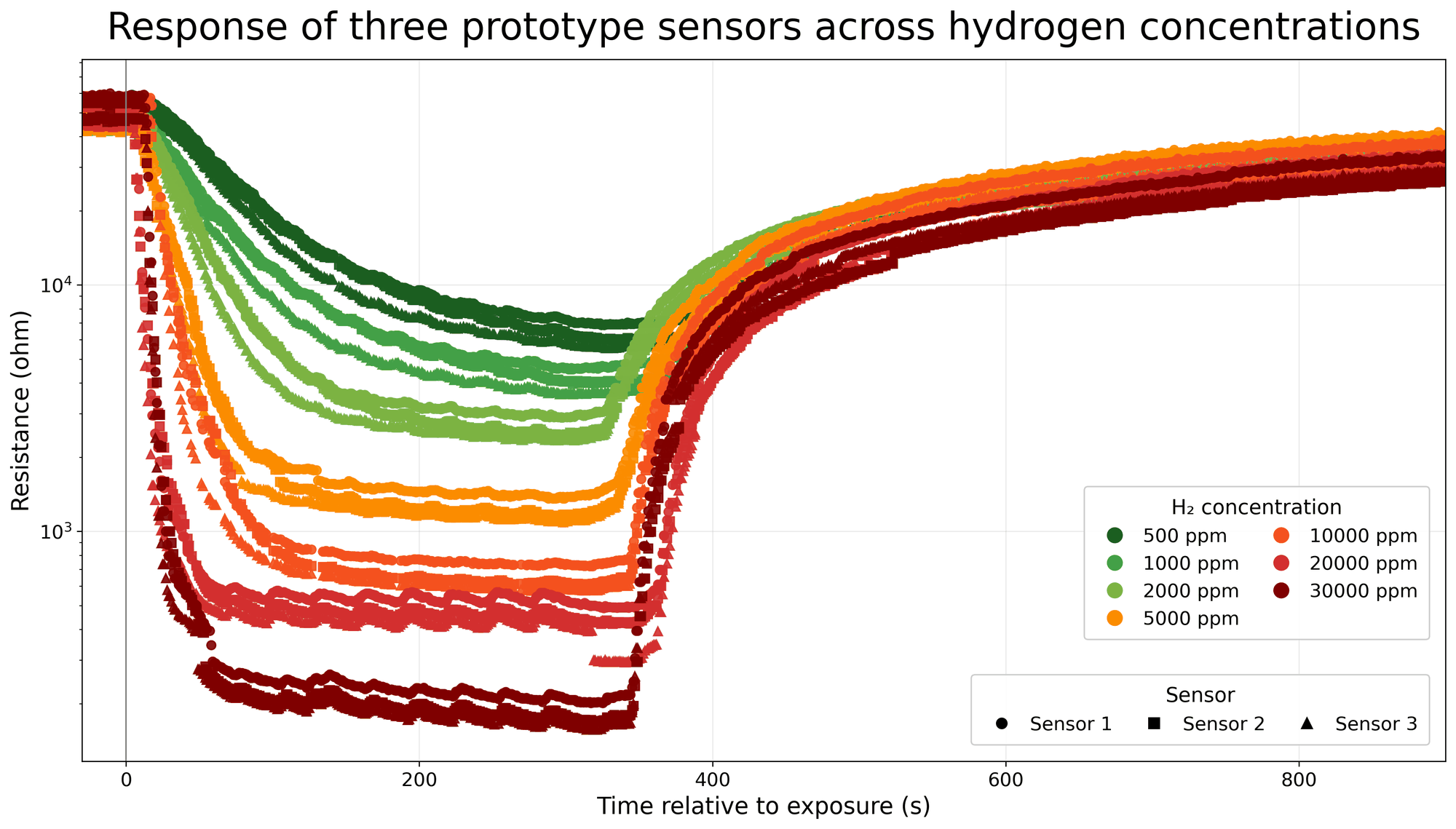
Measured resistance response of three NSI prototype sensors during exposure to hydrogen at concentrations from 500 to 30,000 ppm, followed by recovery after hydrogen removal. Resistance is shown on a logarithmic scale against time in seconds.

NSI sensors show consistent, fast responses across the tested hydrogen concentrations below 4%. Their strong signal without heating provides the foundation for simple gas-presence alarms across a wide range of non-condensing conditions. Wet environments require application-specific mitigation. NSI sensors are not certified safety detectors.

About Novel Sensors Inc.

Built on decades of hydrogen technology experience.

NSI’s founders bring six decades of combined experience in the fuel-cell and hydrogen industries. NSI is developing a new class of gas sensors based on newly discovered material properties.

More about NSI →

Talk to NSI.

Let’s explore how an NSI pilot project could address your gas sensing challenge.

haas@novelsensors.com